Deer Behavior During the Rut, Phase by Phase
Most of the year, a mature buck barely exists as far as daylight is concerned. He beds in the nastiest tangle on the farm, gets up after dark, and somehow always knows which gate the hunters come through.
Then the rut comes along. And that same buck? He’s out in a picked bean field at 11 a.m., nose in the dirt, too busy to notice the hunter in the treestand who can’t quite believe what’s happening.
The rut is breeding season. For roughly two months, deer act in ways they won’t the rest of the year, and they don’t do it all at once. There are phases, and each one looks different from the stand. New hunters get tripped up by this all the time: deer everywhere one week, gone the next, then popping up in spots that make zero sense. Learn the phases and most of that stops being a mystery.
What Triggers the Rut
Many hunters believe cold weather starts the rut. It’s an easy assumption, since the rut and the first real cold snaps tend to arrive together. The actual trigger is daylight.
Shorter days flip a hormonal switch. Bucks get hit first. Their testosterone climbs, the antlers harden, and the velvet dries out and hangs off in ragged, sometimes bloody strips until it’s rubbed away. By late October a mature buck’s neck can get so thick it looks borrowed from a bigger animal. Does are on the same clock. That’s why most of them come into heat within a few weeks of each other.
Since daylight doesn’t change from year to year, the rut in a given spot shows up at nearly the same time every fall. Where that spot is matters, though. Some regions run a month or more behind others, so take the dates below as ballpark numbers. For local specifics, most state wildlife agencies post breeding dates online.
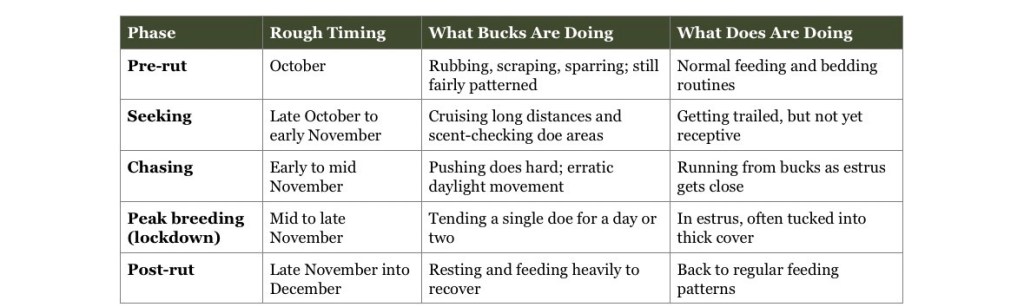
Timing is approximate and shifts by region. The order of the phases stays the same.
The Pre-Rut
Pre-rut is when the woods start to feel different. A trail that was bare in September now has a sapling with the bark peeled off at knee height, the pale wood underneath still wet. A few days later there’s another one fifty yards down the trail, and another past that.
Those are rubs. A buck makes them by grinding his antlers and forehead against a tree, leaving scent from glands on his head. Other deer come by, smell it, and know who’s been there. A line of rubs along a trail is about as clear a sign of a buck’s travel route as a beginner will ever find.
Scrapes show up around the same time. They’re patches of bare dirt, often a couple of feet across, pawed out under a low-hanging branch. The buck works that branch over with his mouth and face, then usually pees in the scrape for good measure. A fresh one stinks. Kneel down next to it and there’s a sharp, musky odor, something close to a wet dog, that nobody forgets after smelling it once.
Bucks that spent the summer together in bachelor groups start sparring, too. It’s mostly shoving and antler clicking, a way to sort out who’s boss before the does are ready.
This is homework season. Bucks haven’t abandoned their routines yet, so they’re still eating and bedding in the same general spots. Hang a trail camera on a busy scrape for a couple of weeks and it’ll show a lot: which bucks are around, how big they are, and what time they tend to come through.
Seeking
Somewhere around the last week of October, bucks start wandering. One that lived on a few hundred acres all summer might put on several miles in a single day, going from one bunch of does to the next and scent-checking every bedding area he passes.
Daylight sightings pick up. Usually it’s a lone buck, head low, trotting along like he’s late for something. The does aren’t ready yet, so there isn’t much chasing. The bucks are just looking.
They like to travel where it’s easy and where cover is close, like:
Saddles and low spots in ridges
Creek crossings
Inside corners of fields
Brushy fencerows or strips of timber between two woodlots
Those spots are worth scouting on any property.
Scrapes are usually busiest during this phase. Then, once chasing starts, many of them go cold. Plenty of new hunters have watched a scrape get torn up every night for two weeks, only to see it sit untouched right when things should be heating up. The bucks haven’t gone anywhere. They’ve just switched from checking scrapes to following does.
Chasing
When the first does get close to heat, the woods get loud. A lot of the time the chase is heard first. Leaves crash. A stick pops. Then a doe busts through with a buck a few yards behind her, letting out a low, choppy grunt with nearly every step.
She’s not ready yet, so she runs. He follows. Some chases cover a few hundred yards and disappear. Others loop around the same little patch of woods for half an hour. And two or three bucks strung out behind one doe, like a small parade, isn’t a rare sight at all.
Other signs that chasing has started:
Does running with their tails tucked or held straight out, looking back over their shoulders
Bucks crossing open fields in the middle of the day
Real fights between mature bucks, which are much more violent than the sparring earlier in the fall
This stretch brings some of the best daytime movement of the season, but it’s hard to predict. Bucks go wherever the does go, so doe bedding and feeding areas are a better bet now than a scrape.
When the Woods Go Quiet
Anyone who’s hunted the peak of the rut knows the feeling. A week earlier, bucks were running all over. Now it’s a whole morning of nothing but squirrels, and it starts to feel like every deer in the county packed up and left.
Hunters call it the lockdown. What’s going on is pretty simple. A doe is only willing to breed for about a day, a day and a half at most. Once a buck finds her, he doesn’t leave (biologists call this tending). He’ll push her off somewhere thick and out of the way, far from other bucks, and the pair might not move more than a few yards until her window closes.
Now picture that happening with a dozen does in the same week. Half the bucks on the property are suddenly holed up somewhere, and usually not where anybody expects. Think a brushy spot the size of a living room out in the middle of an open field, an overgrown fencerow, or the cattails along a marsh edge.
Lockdown doesn’t hang around long, which is the good part. As soon as a buck is done with one doe, he’s up and looking for the next one, often in broad daylight. Hunters willing to sit through the middle of the day during lockdown are the ones most likely to catch him on the move.
The Post-Rut and the Second Rut
By the end of the main rut, bucks look rough. Weeks of chasing and fighting with little time to eat can cost a buck 20 percent or more of his body weight. His ribs may show, and that swollen neck starts to shrink back down.
Once breeding winds down, food becomes the priority again. Deer pile onto the best remaining food sources, especially once the real cold sets in, and they can become fairly predictable.
The rut has one more round in it, though. A doe that doesn’t get bred will come back into heat about 28 days later. Some doe fawns born that spring will also come into heat for the first time in late fall if they’ve had good feed. The result is the second rut. It’s shorter and quieter than the main event, but a tired buck will still get up and go when he smells a doe in heat, even in December.
Weather, Pressure and the Moon
The rut happens on schedule, but how much of it happens in daylight depends on a few things.
Temperature is the big one. Deer have their full winter coats by November. Wear that through a 70-degree afternoon and it’s no mystery why they stay bedded. Nobody wants to jog in a parka. A strong cold front usually flips that around. The first frosty, calm morning after a front comes through is a morning worth being in the woods.
Pressure is next. Older bucks figure things out quickly. On land with trucks pulling in every morning and hunters in every tree line, a lot of the rutting moves to the night shift, or deep into cover nobody bothers to push through. Wind does something similar. On a blustery day deer can’t trust their ears or their nose, so plenty of them just stay put.
Then there’s the moon, which can start an argument at any deer camp in the country. Some hunters plan their time off around moon phase. The research is mixed, and most studies haven’t found that the moon changes when does are bred. It may nudge daily movement a little, but temperature and pressure matter a lot more.
Reading the Signs
For anyone still learning, the deer are a better guide than the calendar. What they’re doing on a given day matters more than what the dates say should be happening. Fresh rubs and scrapes point to pre-rut or seeking. Running does and grunting bucks mean chasing is on. A sudden quiet in mid-November is probably lockdown, and it usually breaks within a week or so.
It also helps to keep a few notes each season: dates, weather, and what showed up. A couple of years of those notes will say more about the rut on one particular piece of ground than any article can.
 graydogoutdoorhome